A golf cart solenoid that clicks when you press the pedal, while the cart stays put, is one of the most common fault reports on Club Car, EZGO and Yamaha electric carts. The click is useful information: it means the solenoid coil is getting power and the pedal switch is working. What it does not tell you is whether the heavy contacts inside the solenoid are actually closing.
What the solenoid does
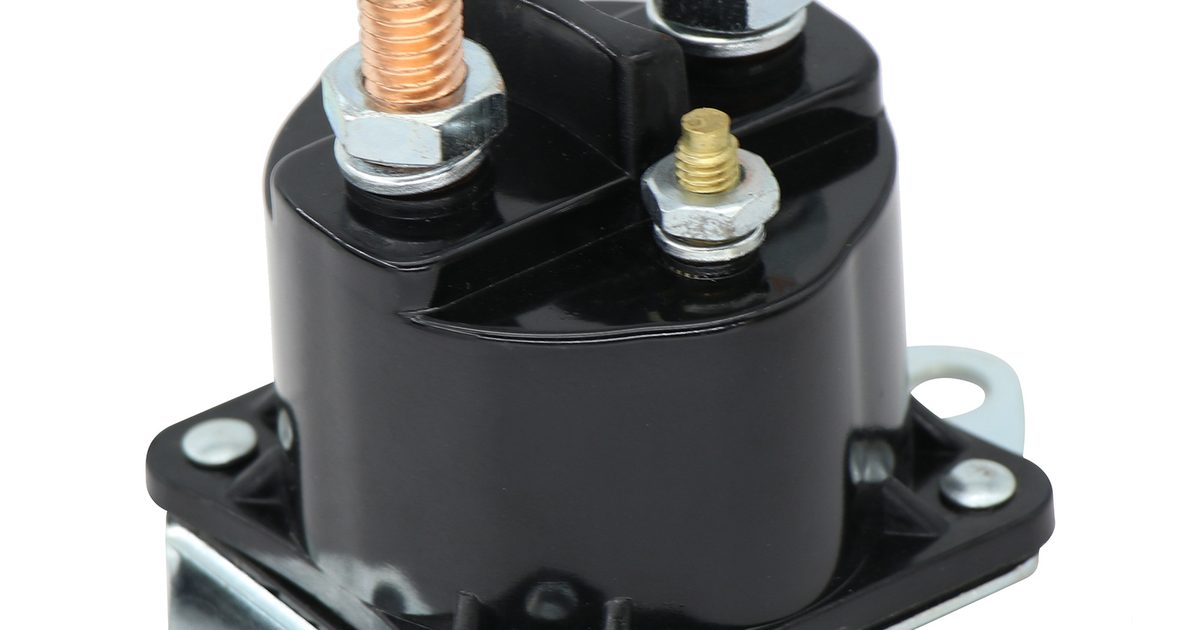
On an electric cart the solenoid is a heavy relay. The key switch and pedal circuit energise a small coil inside it; the coil pulls a contact bar across two large terminals, connecting the battery pack to the controller. When the contacts are burnt or pitted, the coil still clicks but the current path stays open — so the cart does not move even though everything sounds normal.
Test it in five minutes
- Put the cart on a flat surface, switch the key on and make sure the forward/reverse selector is in a drive position.
- Set a multimeter to DC volts and measure across the two large solenoid terminals with the pedal released. On most carts you should read close to full pack voltage.
- Have a helper press the pedal so the solenoid clicks, and measure again. If the reading stays high, the contacts are not closing — replace the solenoid.
- If the reading drops to near zero and the cart still does not move, the solenoid is working and the fault is downstream: the controller, the motor, or the throttle signal.
- If there is no click at all, the fault is in the coil circuit — key switch, pedal switch, run/tow switch or the wiring to the coil.
Do not bypass a solenoid to “test” it by jumping the large terminals with a screwdriver. On a cart in gear that turns the motor, and it can arc and weld the terminals.
What usually causes it
On Club Car carts the solenoid is often replaced together with the accelerator box diagnosis, because a failing MCOR can leave the solenoid energised or chattering. See the Club Car electric parts guide and the Club Car DS and Precedent hubs for the matching parts.
On EZGO TXT carts the solenoid is a service item and a classic no-move cause; the EZGO TXT parts hub lists the 36V and 48V solenoids and contactors. On EZGO RXV and on Yamaha carts the contactor is part of a more integrated drive system, so a no-move fault can also be a speed sensor or controller fault — see the RXV hub and the Yamaha electric parts guide.
Replacing the solenoid
Before ordering, note the coil voltage and the terminal layout: a 36V solenoid and a 48V solenoid are not interchangeable, and the mounting bracket pattern varies between carts. Match the OEM number on the old solenoid where it is legible. Then:
- Disconnect the main pack negative before touching the heavy cables.
- Photograph the terminal layout before removing the cables — the small coil wires are easy to swap.
- Fit the new solenoid to the bracket first, then reconnect the heavy terminals and the coil wires.
- Reconnect the pack and test with the pedal: a single clean click and movement is the expected result.
Frequently asked questions
Can a solenoid click and still be bad?
Yes — that is the most common failure mode. The click only proves the coil works; the heavy contacts inside can be burnt, which is why the meter test above matters.
Should I replace the solenoid or the controller first?
The solenoid, always. It is far cheaper and it is the part that fails most often. Only replace a controller after the solenoid and throttle signal have been verified.
Do I need to replace anything else at the same time?
Check the small coil wires and the terminal studs while you are in there. If the cart has a run/tow switch or an accelerator box that has been intermittently failing, replace those in the same job — the motors and controllers category covers the related parts.